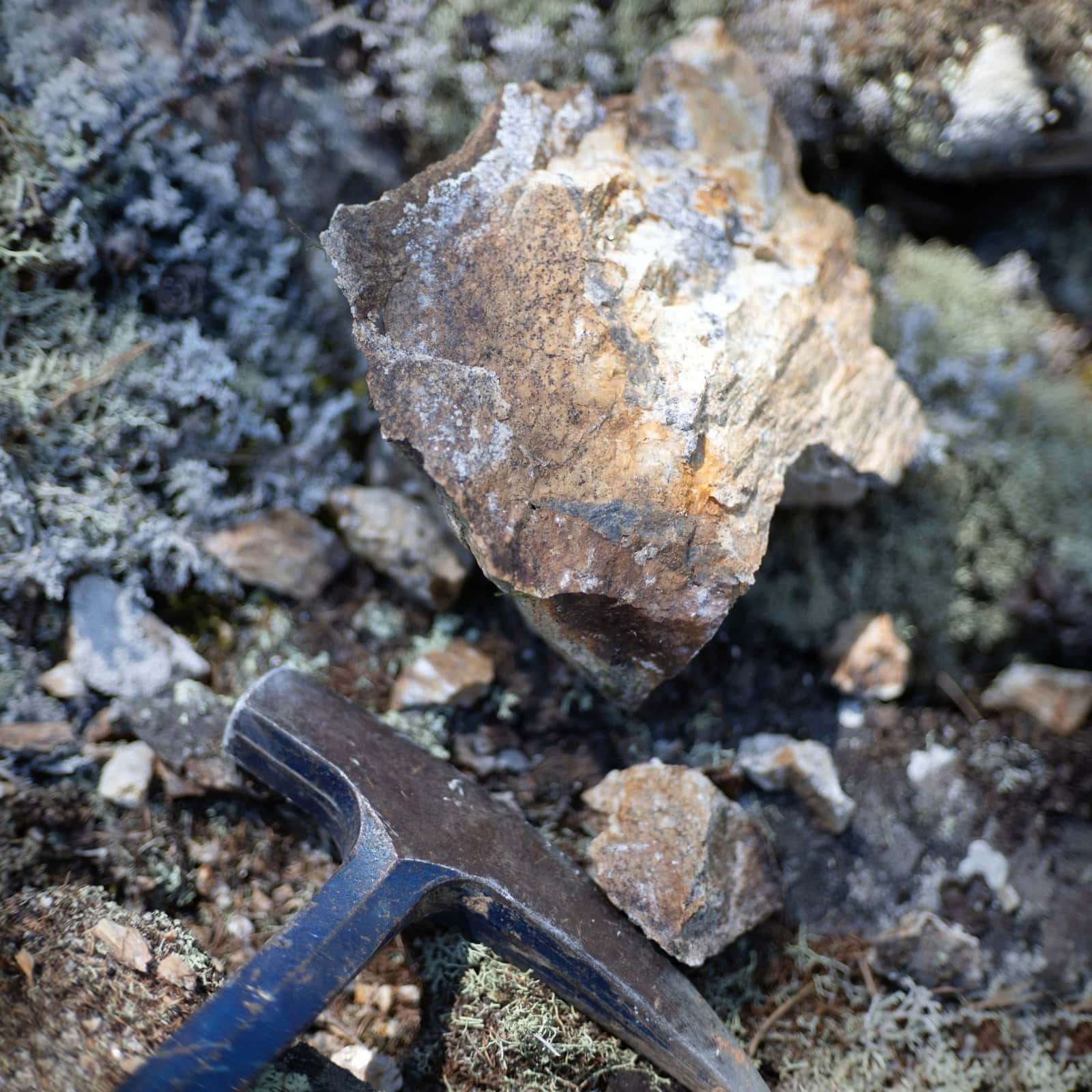
- A mineral claim gives the holder rights to minerals in a defined area, not ownership of the land, and those rights are granted by the province or territory.
- Claims are kept by doing qualifying exploration work or paying instead, by set deadlines. Miss the deadline and the claim can be forfeited.
- A company that "owns 100%" usually holds all of the claims, but royalties, option terms and permits can still limit what it keeps or can do.
Introduction
Junior mining releases often describe a property as "100% owned". That phrase sounds like a deed to land. In most of Canada it means something narrower: the company holds mineral claims, which are rights to explore for and develop minerals, granted by the province or territory on conditions that have to be met to keep them.
This guide uses British Columbia as the main example, because its rules are published in detail and many TSXV and CSE explorers work there. Each province and territory has its own legislation and its own terms, so check the rules where a property sits.
A claim is a conditional right to minerals. It is not a title to the land above them.
Who Owns the Minerals
Mining in Canada is mostly a provincial and territorial matter. Natural Resources Canada's 2013 guide described the provinces and territories as responsible for mining within their jurisdictions, with the federal government responsible at that time in Nunavut, the Northwest Territories and on reserves.
Ownership of minerals is often separate from ownership of the surface. British Columbia's government puts it plainly: most private landowners in BC do not own the mineral rights. Some do, in rare cases such as certain old Crown-granted claims, and a land title search shows which.
That separation is why an exploration company can hold mineral rights under land it does not own. British Columbia's rules also require a free miner to notify a private landowner before entering the property for exploration and development.
What a Claim Gives the Holder
According to British Columbia's Mineral Titles branch, a mineral claim gives the holder the available mineral and placer mineral rights in the claim area that have not already been granted to someone else. It does not include:
- minerals already held under an earlier claim or other title;
- rights over alienated land such as parks;
- sand and gravel, which are not minerals under the Act and need a separate tenure;
- permission to start work. Holders may not carry out mining activity until they receive any permit required under the Mines Act.
A claim also does not authorize a cabin or a camp on its own. That takes a separate permit or tenure.
Staking Online
Claims have traditionally been staked by marking boundaries on the ground. NRCan's 2013 guide describes a claim being filed at the mining recorder's office with a map of the claim post boundaries and a registration fee.
In British Columbia, claims are applied for through Mineral Titles Online. An applicant selects one or more adjoining cells on an electronic map and pays a fee per hectare. Since March 26, 2025, under the Province's Mineral Claims Consultation Framework, that selection is an application rather than an instant registration: provincial staff consult affected First Nations, and the chief gold commissioner then decides whether to register the claim, register it with accommodations, or deny it. Cells range from roughly 16 hectares in the north to about 21 hectares in the south, and one application can cover up to 100 cells. Applicants need a free miner certificate.
Applying for ground online is still inexpensive compared with exploring it. A large land package is not, by itself, evidence of anything in the ground. A company can hold thousands of hectares on the strength of a map.
Keeping a Claim
A claim does not last forever. In British Columbia, a cell claim runs one year from registration to its expiry date. To keep it, the holder must, before that date:
- register qualifying exploration and development work done on the claim; or
- make a cash in lieu payment instead.
The work requirement per hectare rises as the claim ages, and cash in lieu costs double the work requirement. Registered work can push the expiry date forward by up to ten years; a cash payment advances it by six months to a year. Reports on the work are due after it is registered.
If none of this happens, the claim forfeits at midnight on the expiry date. The government does not send a notice first. The rules state that it is every recorded holder's responsibility to maintain their claims.
For investors, this explains two things. First, juniors spend money on properties partly to keep them. Second, a company short of cash may let claims lapse, which shows up as a smaller land package.
Claims vs Leases
A claim is mainly an exploration right. British Columbia describes a mining lease as the production tenure for mining: claims limit how much ore can be extracted, so production beyond those limits requires a lease. Leases are issued according to a survey plan, run for a set term, carry annual rent per hectare, and can be renewed only if needed for mining.
So a company moving toward production will usually need to convert at least part of its claims into a lease, alongside the environmental and mining permits a mine needs.
What "Owns 100%" Usually Means
When a company says it owns 100% of a property, it usually means it is the registered holder of all the claims. Several things can still sit on top of that:
- Royalties. A previous owner or a financier may hold a royalty on future production.
- Option or earn-in terms. The company may hold the claims but owe payments or work to someone else, or have earned its interest only recently.
- Back-in rights. A former owner may have the right to buy back an interest later.
- Permits and access. Holding claims does not mean the company can drill tomorrow.
- Overlapping interests. Parks, other titles and existing rights carve ground out of the claim.
The rules expect this to be disclosed. Form 43-101F1, the technical report form under National Instrument 43-101, asks for the type of mineral tenure, the nature and extent of the company's title or interest including surface rights and legal access, the obligations that must be met to retain the property, the expiry dates of claims, and the terms of any royalties, back-in rights, payments or other agreements. Our guide to NI 43-101 resource estimates covers the rest of the report.
What to Check
- Tenure type. Claims, leases or other titles, and how many.
- Expiry dates and obligations. What work or payments are due, and when.
- Encumbrances. Royalties, option payments and back-in rights.
- Surface rights and access. Who owns the surface and how the company gets there.
- Permits. What the company has, and what it still needs for its planned work.
- The registry. Provincial tenure systems show the status of individual titles.
A mineral claim is a real asset, but a conditional one. For decisions, read the property section of the technical report on SEDAR+ and speak with your own adviser.
Frequently asked questions
- New framework introduced for First Nations consultation on mining claims, Government of British Columbia, 2025-03-26
- Mineral and placer claims, Government of British Columbia, Mineral Titles, 2025-06-26
- Claims FAQ, Mineral Titles, Government of British Columbia, 2025-03-25
- Private Property FAQ, Mineral Titles, Government of British Columbia, 2025-03-25
- Mineral and placer leases, Government of British Columbia, Mineral Titles, 2025-04-02
- Exploration and Mining Guide for Aboriginal Communities, Natural Resources Canada, 2013-04-03. Published 2013 with industry and federal partners; date is the catalogue record date
- Form 43-101F1 Technical Report (unofficial consolidation), Ontario Securities Commission, 2011-06-30
This article is published by Bellmare Capital, a brand operated by Apollo Shareholder Relations, for information and education only. It is not investment advice, a recommendation, or an offer or solicitation to buy or sell any security. Bellmare Capital is not a registered investment adviser or dealer, and this is not independent research.
Apollo Shareholder Relations provides paid investor relations, marketing and communications services to public companies, including companies in the sectors Bellmare Capital writes about, and may be compensated in cash or securities. Apollo, its principals, employees and contractors may hold securities of companies discussed and may buy or sell them at any time. Where an article covers a company that pays Apollo, it is labelled Sponsored at the top with the compensation and holdings.
Information comes from public filings and other sources believed to be reliable, but its accuracy and completeness are not guaranteed, and it may be out of date. Small cap and junior resource companies are speculative and volatile, and investors can lose their entire investment. Bellmare Capital and Apollo Shareholder Relations accept no liability for any loss arising from use of this content. Read each company's own filings on SEDAR+ and consult a registered adviser before acting.
Get the next one by email.