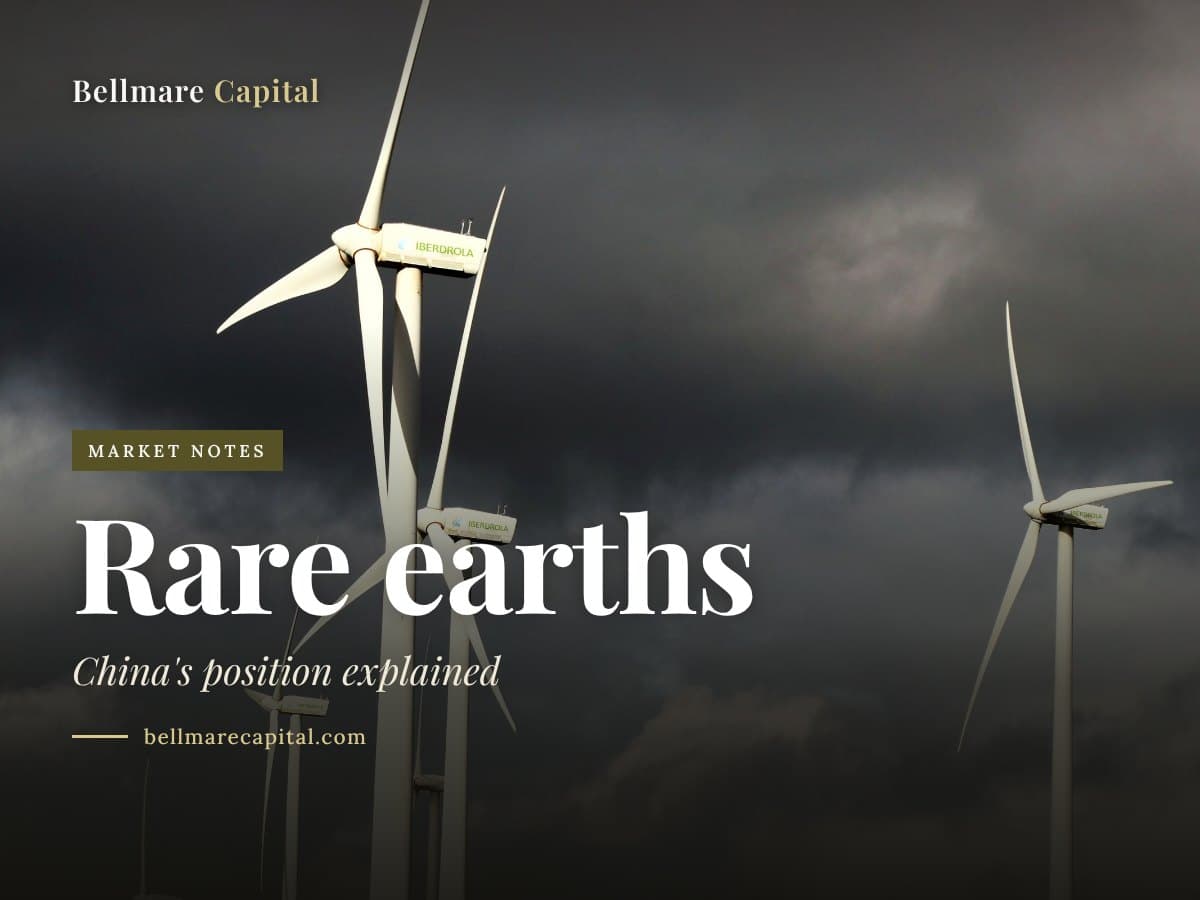
- Rare earth elements (REEs) are a group of 17 metals essential to magnets, defense systems, and clean energy hardware.
- China dominates downstream processing of REEs and a large share of mining.
- Several Western jurisdictions are funding projects to build out non-Chinese supply, but lead times are long.
What are rare earth elements?
Rare earth elements are a group of 17 chemically similar metals: the 15 lanthanides plus scandium and yttrium. The most commercially important for clean energy and defense applications are neodymium, praseodymium, dysprosium, and terbium, used in high-strength permanent magnets.
Why China dominates the value chain
China mines a large share of the world’s REEs and processes an even larger share. Most rare earth oxide separation capacity is in China, as is most magnet manufacturing. This concentration is the result of decades of investment, scale, and lower environmental costs.
Why processing matters more than mining
Mining REE-bearing ore is feasible in many jurisdictions. The difficult step is separating the chemically similar lanthanides into individual oxides, then converting them to metal and magnets. Western jurisdictions have very limited capacity at each of these downstream steps.
What is being done outside China
Australia, the United States, and Canada have announced funding and offtake support for new mines and processing facilities. Several European projects are also in development. Building greenfield separation and magnet capacity typically takes many years.
Implications for investors
REE juniors fall into mining-only and integrated mine-to-magnet categories. Pure mining projects depend on someone else building processing. Integrated projects carry higher capital costs but capture more of the value chain. Investors should understand which stage of the chain a project addresses.
Industry structure and value chain are described in public reports by the US Geological Survey, the International Energy Agency, and government critical mineral strategies.
Frequently asked questions
Industry structure and value chain are described in public reports by the US Geological Survey, the International Energy Agency, and government critical mineral strategies.
This article is published by Bellmare Capital, a brand operated by Apollo Shareholder Relations, for information and education only. It is not investment advice, a recommendation, or an offer or solicitation to buy or sell any security. Bellmare Capital is not a registered investment adviser or dealer, and this is not independent research.
Apollo Shareholder Relations provides paid investor relations, marketing and communications services to public companies, including companies in the sectors Bellmare Capital writes about, and may be compensated in cash or securities. Apollo, its principals, employees and contractors may hold securities of companies discussed and may buy or sell them at any time. Where an article covers a company that pays Apollo, it is labelled Sponsored at the top with the compensation and holdings.
Information comes from public filings and other sources believed to be reliable, but its accuracy and completeness are not guaranteed, and it may be out of date. Small cap and junior resource companies are speculative and volatile, and investors can lose their entire investment. Bellmare Capital and Apollo Shareholder Relations accept no liability for any loss arising from use of this content. Read each company's own filings on SEDAR+ and consult a registered adviser before acting.
Get the next one by email.