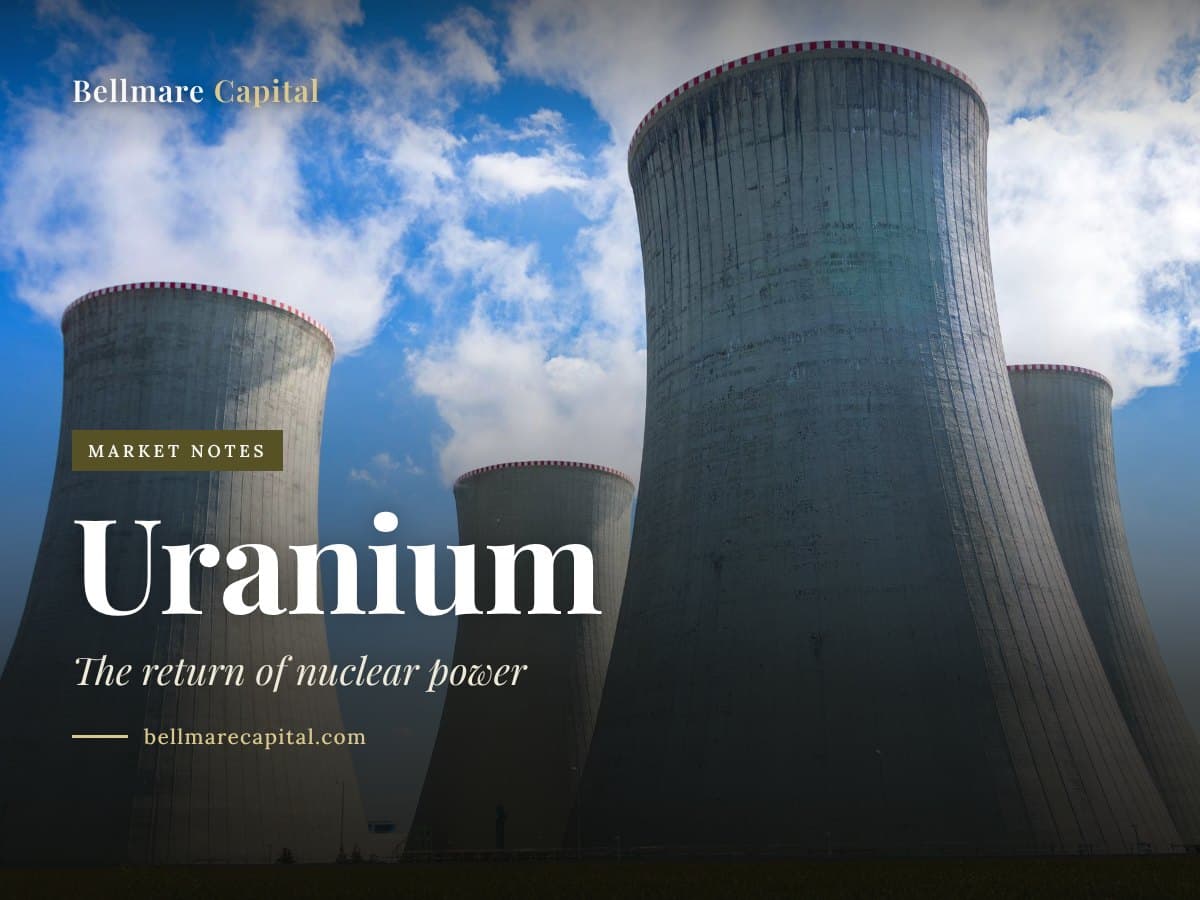
- Uranium demand depends on the global reactor fleet and on the term contracts utilities sign for fuel.
- Several major economies have shifted to a more supportive stance on nuclear power since 2022.
- New mine supply is constrained by long permitting timelines, especially in OECD jurisdictions.
What drives the uranium market?
Uranium demand comes from operating nuclear reactors that need fuel. Utilities typically buy uranium through long-term contracts with miners or converters. Reactor restarts, new builds, and lifetime extensions all increase demand; permanent shutdowns reduce it.
The post-Fukushima decade
After the 2011 Fukushima accident, several countries paused or reversed nuclear policy. Spot uranium prices fell, and many mines were placed on care and maintenance. The result was a decade of underinvestment in new mine supply.
The policy shift since 2022
Energy security concerns after 2022, alongside electrification and climate policy, prompted many countries to revisit nuclear policy. The United States, France, Japan, the United Kingdom, and several others have announced reactor lifetime extensions, new builds, or small modular reactor (SMR) programs.
Supply concentration
Uranium mine supply is concentrated. Kazakhstan, Canada, Namibia, and Australia are the largest producing countries. Kazakhstan alone supplies a substantial share of the world’s mined uranium, almost all by in-situ recovery.
The fuel cycle
Mined uranium concentrate (U3O8) is converted to uranium hexafluoride (UF6), then enriched, then fabricated into fuel assemblies. Each stage has its own market and pricing. Conversion and enrichment capacity have also been tight, contributing to the overall fuel-cycle squeeze.
Industry structure and supply concentration are documented in publications by the World Nuclear Association, the OECD Nuclear Energy Agency, and Cameco Corporation.
Frequently asked questions
Industry structure and supply concentration are documented in publications by the World Nuclear Association, the OECD Nuclear Energy Agency, and Cameco Corporation.
This article is published by Bellmare Capital, a brand operated by Apollo Shareholder Relations, for information and education only. It is not investment advice, a recommendation, or an offer or solicitation to buy or sell any security. Bellmare Capital is not a registered investment adviser or dealer, and this is not independent research.
Apollo Shareholder Relations provides paid investor relations, marketing and communications services to public companies, including companies in the sectors Bellmare Capital writes about, and may be compensated in cash or securities. Apollo, its principals, employees and contractors may hold securities of companies discussed and may buy or sell them at any time. Where an article covers a company that pays Apollo, it is labelled Sponsored at the top with the compensation and holdings.
Information comes from public filings and other sources believed to be reliable, but its accuracy and completeness are not guaranteed, and it may be out of date. Small cap and junior resource companies are speculative and volatile, and investors can lose their entire investment. Bellmare Capital and Apollo Shareholder Relations accept no liability for any loss arising from use of this content. Read each company's own filings on SEDAR+ and consult a registered adviser before acting.
Get the next one by email.