- Lithium-ion battery anodes are typically made from graphite.
- Graphite supply is split between natural flake graphite and synthetic graphite made from petroleum coke.
- China dominates both natural graphite mining and anode-grade graphite processing.
Why graphite matters for batteries
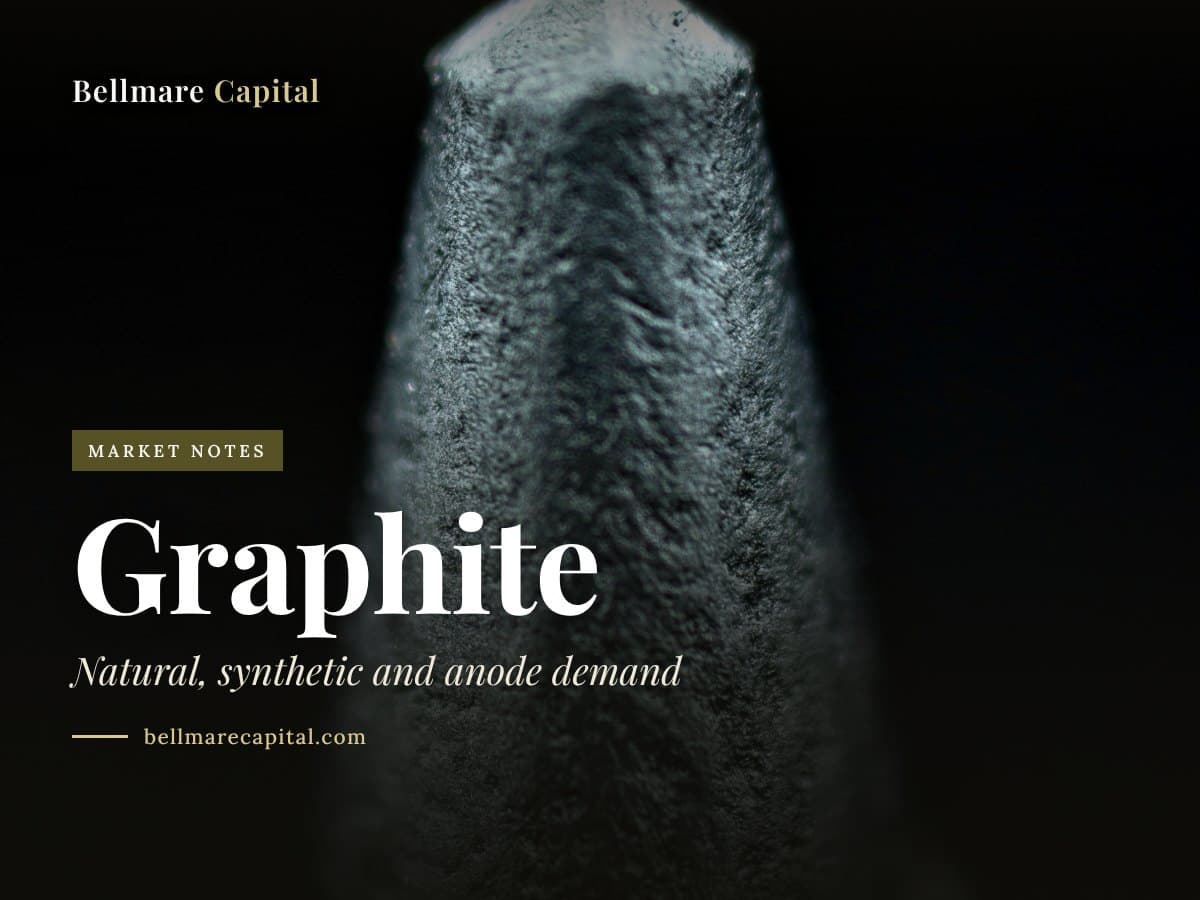
The anode in a typical lithium-ion battery is made primarily of graphite. While silicon anode research is active, commercial cells still use graphite as the dominant anode material. Battery demand has made graphite a strategic material.
Natural vs synthetic graphite
Natural graphite is mined and then upgraded into spherical purified graphite for battery use. Synthetic graphite is made from petroleum coke through high-temperature processing. Each has cost, performance, and environmental tradeoffs.
China’s role
China dominates both natural graphite mining and anode-grade processing. A large majority of the world’s spherical purified natural graphite and synthetic anode material is produced in China. Diversification efforts are underway in Canada, Mozambique, Australia, and elsewhere.
Anode supply chain steps
Mining flake graphite is only the first step. The flake must be purified, shaped (spheronization), and coated to become anode-grade material. Each step adds value and is itself concentrated in China.
Why graphite is a critical mineral
Graphite appears on Canadian, US, and EU critical mineral lists because of its essential role in lithium-ion batteries and the supply concentration in China. Several non-Chinese projects are advancing under government support programs.
| Natural graphite | Synthetic graphite | |
|---|---|---|
| Origin | Mined flake | Petroleum coke processed at high temperature |
| Energy intensity | Lower | Higher |
| Performance | Lower cost, slightly lower cycle life | Higher cost, longer cycle life |
| Supply concentration | China and Mozambique dominate | China dominates |
Industry structure and supply concentration are described by the US Geological Survey, Natural Resources Canada, and the International Energy Agency.
Frequently asked questions
Industry structure and supply concentration are described by the US Geological Survey, Natural Resources Canada, and the International Energy Agency.
This article is published by Bellmare Capital, a brand operated by Apollo Shareholder Relations, for information and education only. It is not investment advice, a recommendation, or an offer or solicitation to buy or sell any security. Bellmare Capital is not a registered investment adviser or dealer, and this is not independent research.
Apollo Shareholder Relations provides paid investor relations, marketing and communications services to public companies, including companies in the sectors Bellmare Capital writes about, and may be compensated in cash or securities. Apollo, its principals, employees and contractors may hold securities of companies discussed and may buy or sell them at any time. Where an article covers a company that pays Apollo, it is labelled Sponsored at the top with the compensation and holdings.
Information comes from public filings and other sources believed to be reliable, but its accuracy and completeness are not guaranteed, and it may be out of date. Small cap and junior resource companies are speculative and volatile, and investors can lose their entire investment. Bellmare Capital and Apollo Shareholder Relations accept no liability for any loss arising from use of this content. Read each company's own filings on SEDAR+ and consult a registered adviser before acting.
Get the next one by email.