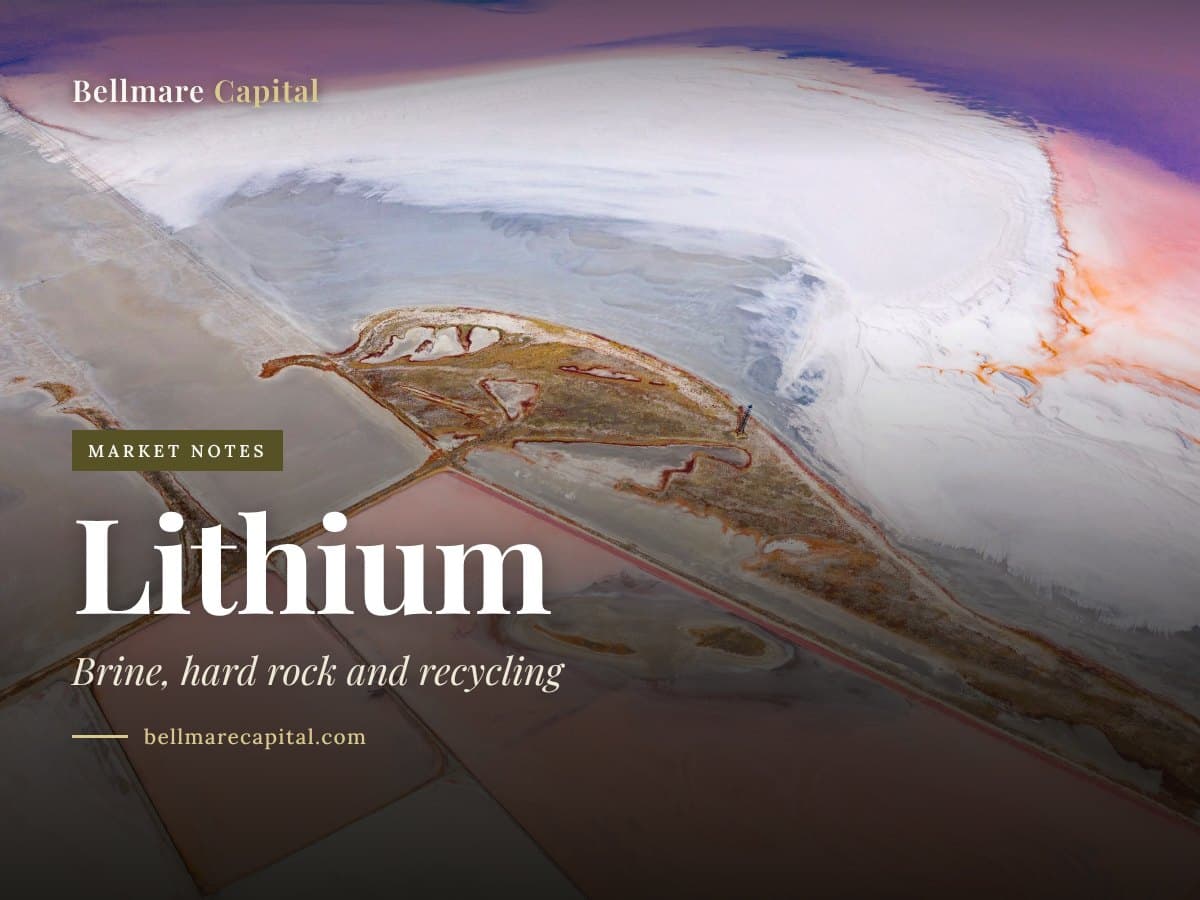
- Today’s lithium supply is split between brine operations (mostly South America) and hard rock spodumene mining (mostly Australia and now China).
- Battery recycling is a small but growing source.
- Each route has different capital cost, operating cost, environmental footprint, and lead time.
What are the three lithium supply routes?
Lithium reaches the market through brine evaporation (in the Lithium Triangle of Chile, Argentina, and Bolivia), hard rock spodumene mining (primarily in Western Australia and now China and Canada), and battery recycling. Each route has a different cost structure, environmental footprint, and time to market.
Brine operations
Brine operations pump lithium-bearing salt water from underground reservoirs into large evaporation ponds. The process takes months and depends on solar and wind energy. Cost per tonne is generally low once a brine field is in production, but new projects require very long permitting and construction timelines and large land footprints.
Hard rock spodumene
Spodumene is a lithium-bearing mineral mined from hard rock, then concentrated and converted to lithium hydroxide or carbonate at a separate chemical plant (often in China). Hard rock projects can be built faster than brines and respond more quickly to price signals, but unit operating costs are typically higher.
Battery recycling
End-of-life batteries are an emerging source of lithium and other battery metals. Today recycling supplies a small share of demand because there are not yet enough end-of-life batteries to recycle. Over time recycling becomes more important as the installed EV base ages.
Implications for investors
Different supply routes have different risk profiles. Brine projects are typically slow, capital-intensive, and exposed to local water and permitting politics. Hard rock projects are more responsive but higher cost. Recycling is small now but a meaningful long-term source. Diversified exposure across routes spreads route-specific risk.
| Route | Typical geography | Capital intensity | Time to first production |
|---|---|---|---|
| Brine | Chile, Argentina, Bolivia | High | Many years |
| Hard rock (spodumene) | Australia, China, Canada | Moderate to high | Several years |
| Recycling | OECD | Moderate | Limited by EOL battery availability |
Public-domain summaries from the US Geological Survey, Natural Resources Canada, and the International Energy Agency.
Frequently asked questions
Public-domain summaries from the US Geological Survey, Natural Resources Canada, and the International Energy Agency.
This article is published by Bellmare Capital, a brand operated by Apollo Shareholder Relations, for information and education only. It is not investment advice, a recommendation, or an offer or solicitation to buy or sell any security. Bellmare Capital is not a registered investment adviser or dealer, and this is not independent research.
Apollo Shareholder Relations provides paid investor relations, marketing and communications services to public companies, including companies in the sectors Bellmare Capital writes about, and may be compensated in cash or securities. Apollo, its principals, employees and contractors may hold securities of companies discussed and may buy or sell them at any time. Where an article covers a company that pays Apollo, it is labelled Sponsored at the top with the compensation and holdings.
Information comes from public filings and other sources believed to be reliable, but its accuracy and completeness are not guaranteed, and it may be out of date. Small cap and junior resource companies are speculative and volatile, and investors can lose their entire investment. Bellmare Capital and Apollo Shareholder Relations accept no liability for any loss arising from use of this content. Read each company's own filings on SEDAR+ and consult a registered adviser before acting.
Get the next one by email.